Content Overview
- Introduction
- Early benzodiazepine research and the search for antagonists
- Discovery of Ro 15-1788 (flumazenil)
- Structural features and receptor pharmacology
- Preclinical characterization as a GABA-A benzodiazepine-site ligand
- Transition from laboratory compound to registered drug
- Flumazenil in neuropharmacology and receptor research
- Development of radiolabeled flumazenil for PET imaging
- Modern studies on GABA-A receptor plasticity and modulation
- Emerging research directions and engineered systems
- Summary
- FAQ
- References
Introduction
Flumazenil is one of those compounds that quietly shaped an entire field. Today it’s known as a selective ligand at the benzodiazepine binding site of the GABA-A receptor, and it remains a go-to reference molecule in neuropharmacology. Researchers don’t typically reach for flumazenil to treat anything in the lab. Instead, they use it as a probe, a way to interrogate benzodiazepine-sensitive GABA-A receptors across in vitro, in vivo, and imaging studies.
Getting from its early days as Ro 15-1788 to its current role as a standard research tool took decades of work across medicinal chemistry, receptor pharmacology, and radiochemistry. Knowing that history helps explain why flumazenil still shows up so often as a reference compound in studies of inhibitory neurotransmission.
Early Benzodiazepine Research and the Search for Antagonists
Back in the 1960s and 1970s, benzodiazepines were under heavy investigation for their effects on sedation, anxiety-like behavior, and seizure models. That work led scientists to identify specific binding sites tied to GABA-A receptors. As radioligand binding and receptor purification techniques improved, medicinal chemists started mapping out the structure-activity relationships of compounds acting at the benzodiazepine site.
Most of the effort at the time went into building agonists or partial agonists with specific behavioral profiles. Nobody had really nailed down the idea of a true benzodiazepine antagonist, something that could bind the same site without producing its own pharmacodynamic effects. Even so, structure-activity work happening across several pharmaceutical labs was quietly setting the stage for exactly that kind of discovery.
Discovery of Ro 15-1788 (Flumazenil)
The compound we now call flumazenil came out of exploratory research at Hoffmann-La Roche, where chemists were synthesizing imidazobenzodiazepines as part of a larger benzodiazepine program. Ro 15-1788 stood out early on as a high-affinity benzodiazepine-site ligand with a strange functional profile. It bound tightly to receptor preparations but didn’t show the positive modulatory effects researchers expected.
Follow-up binding and electrophysiological studies showed that Ro 15-1788 was actually acting as a competitive antagonist at benzodiazepine recognition sites on GABA-A receptors. It blocked the effects of typical benzodiazepine agonists while leaving baseline GABAergic currents mostly untouched in many preparations. That made it the first well-characterized benzodiazepine receptor antagonist. According to historical accounts of its discovery, the finding was partly a happy accident, since the original project wasn’t even aimed at finding antagonists.
Structural Features and Receptor Pharmacology
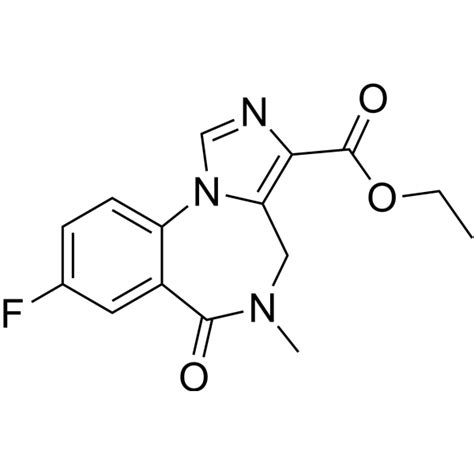
Flumazenil (Ro 15-1788) is an imidazobenzodiazepine derivative, marked by a fluorine substituent and an imidazole ring fused onto the benzodiazepine core. These structural features keep its affinity for the benzodiazepine binding site high while changing how it affects the receptor’s conformation compared to classical agonists.
GABA-A receptors are heteropentameric chloride channels, usually built from α, β, and γ subunits. Flumazenil binds at the benzodiazepine site sitting at the interface of α (α1, α2, α3, or α5) and γ2 subunits on benzodiazepine-sensitive receptors, a mechanism described in more detail on DrugBank. In most receptor assemblies, it acts as a neutral competitive antagonist, displacing both agonists and inverse agonists at the site. That said, some recombinant or subunit-specific setups have revealed weak partial agonist or modulatory effects, which is a good reminder that its functional neutrality isn’t absolute. It depends on context.
Preclinical Characterization as a GABA-A Benzodiazepine-Site Ligand
Once researchers recognized flumazenil’s antagonistic properties, it quickly became an essential reagent in preclinical receptor work. Radioligand binding experiments showed it could displace a wide range of benzodiazepine agonists from brain membrane preparations at high affinity. Electrophysiological recordings, meanwhile, confirmed it could block the potentiation of GABA currents that benzodiazepines usually produce.
This body of work clarified a few key points:
- A discrete benzodiazepine binding site exists on GABA-A receptors
- Benzodiazepine modulation can be pharmacologically separated from direct GABA binding
- Benzodiazepine sensitivity varies depending on receptor subunit composition
Because flumazenil had such clear antagonist properties and reliable binding behavior, it became the reference ligand of choice for mapping benzodiazepine-sensitive GABA-A receptors across synaptosomal preparations, brain slices, and behavioral pharmacology studies. Additional detail on this experimental work is available through PMC’s archive of GABA-A receptor modulation research.
Transition From Laboratory Compound to Registered Drug
While this article stays focused on laboratory and receptor-level research, it’s worth noting that flumazenil’s move from Ro 15-1788 to a registered drug opened the door to wider availability and deeper characterization. Historical sources note it was first characterized in the early 1980s, then introduced in several markets under the trade name Anexate, with formal regulatory approvals following in the late 1980s and early 1990s.
Clinical uses and dosing sit outside the scope of this piece, but that development phase demanded large-scale synthesis, rigorous analytical methods, and thorough pharmacokinetic and safety testing. The data generated during that process locked down flumazenil’s structural identity, purity standards, and stability profile, information that still benefits labs using it as a reference compound today.
Flumazenil in Neuropharmacology and Receptor Research
As receptor theory advanced, flumazenil became a cornerstone of GABA-A receptor pharmacology. In basic research, it’s routinely used to:
- Confirm whether a test compound’s effects run through benzodiazepine-sensitive GABA-A receptors, by checking whether flumazenil blocks or shifts those effects
- Distinguish action at the benzodiazepine site from action at other modulatory sites on the GABA-A receptor, or at entirely separate targets
In electrophysiological work, flumazenil gets applied to brain slices or cultured neurons to reverse the potentiation of inhibitory postsynaptic currents caused by benzodiazepine agonists. If flumazenil brings the GABA response back to normal, researchers can attribute the modulation to benzodiazepine-site activity. In behavioral paradigms, like anxiety-related assays or locomotor tests in animal models, pairing it with benzodiazepine agonists lets researchers quantify how much of the observed behavior actually depends on benzodiazepine-sensitive GABA-A receptors, again without making any clinical claims.
Development of Radiolabeled Flumazenil for PET Imaging
One of the more important extensions of flumazenil’s role in research came with radiolabeled analogues built for positron emission tomography. Labeling flumazenil with carbon-11 or fluorine-18 produced tracers that could bind benzodiazepine-sensitive GABA-A receptors in vivo, opening the door to non-invasive mapping of receptor distribution and occupancy in animal models and humans under research protocols.
Early [¹¹C]flumazenil synthesis work established the basic protocols for producing high-specific-activity tracer with enough radiochemical purity and stability for imaging, as documented in research on flumazenil-based PET tracer development. Later work improved synthesis efficiency and explored [¹⁸F]flumazenil derivatives to extend half-life and widen the range of imaging centers able to use the tracer. One well-known example used [¹¹C]flumazenil PET to study cortical GABA-A receptor binding under pharmacological manipulation, published in Neuropsychopharmacology. In preclinical work, these tracers are valuable for quantifying receptor density, studying occupancy by experimental ligands, and tracking changes in GABA-A receptor availability across different physiological or pharmacological conditions.
Modern Studies on GABA-A Receptor Plasticity and Modulation
More recent research has moved past viewing flumazenil as simply a neutral antagonist, and started looking at its role in more complex receptor dynamics. Some studies have examined how flumazenil influences the surface expression and internalization of specific GABA-A receptor subtypes in model systems. Work on α4βδ-containing receptors and related configurations has looked at whether flumazenil can change internalization rates or trafficking pathways, pointing to context-dependent effects that go beyond simple competition at the benzodiazepine site.
Flumazenil also stays central to research on how GABA-A receptors adapt to long-term exposure to benzodiazepine-site ligands. As a reference antagonist, it helps separate direct GABAergic mechanisms from changes tied specifically to benzodiazepine-site modulation, which supports work on receptor plasticity, synapse remodeling, and homeostatic regulation of inhibitory signaling. This research happens in cell systems and animal models, with the focus staying on receptor and network behavior rather than medical treatment claims.
Emerging Research Directions and Engineered Systems
Current work keeps expanding the scientific relevance of flumazenil. Structural biology has made real progress here, using crystallography and cryo-electron microscopy alongside computational modeling to visualize flumazenil bound within engineered GABA-A receptor constructs. These structures help clarify how flumazenil’s imidazobenzodiazepine scaffold interacts with key residues at the α/γ interface, and how small modifications can shift a ligand from antagonist toward partial agonist behavior.
Engineered receptors with altered flumazenil recognition sites are also being used to break down the contributions of specific amino acids to ligand binding and allosteric coupling. Comparing wild-type and mutant receptor behavior gives researchers insight into how benzodiazepine-site ligands, flumazenil included, stabilize distinct conformational states. Meanwhile, medicinal chemistry efforts sometimes return to the flumazenil scaffold as a starting point for new ligands with tailored affinity, selectivity, or pharmacokinetic properties for experimental use.
Flumazenil also plays a role in multi-modal research strategies that combine PET imaging, electrophysiology, and computational modeling. In these frameworks, flumazenil-based tracers provide in vivo measures of benzodiazepine-site availability, while flumazenil itself serves as a reference ligand in vitro for binding and functional assays. Pulling this data together helps build more complete models of how GABA-A receptor populations are distributed and regulated across brain regions and experimental conditions.
Summary
From its start as Ro 15-1788 in a benzodiazepine discovery program to its current status as a near-universal research tool, flumazenil has played a central role in shaping how we understand GABA-A receptor pharmacology. Early work established it as the first well-characterized benzodiazepine-site antagonist, clarifying the existence and properties of the benzodiazepine binding site itself. Later preclinical studies showed that flumazenil could reliably block benzodiazepine-induced modulation of GABA-A receptors without significantly changing baseline inhibition in most systems.
The development of radiolabeled flumazenil opened up PET imaging of benzodiazepine-sensitive GABA-A receptors, giving researchers a new way to map receptors and study ligand occupancy in living organisms under research protocols. Modern work continues to use flumazenil to study receptor plasticity, trafficking, and allosteric coupling, while structural biology and engineered receptor systems keep refining our understanding of its binding interactions down to the atomic level. Across all these stages, flumazenil has remained a genuinely valuable ligand for studying inhibitory neurotransmission, receptor modulation, and GABA-A receptor biology in laboratory and preclinical settings.
FAQ
What makes flumazenil historically important in receptor pharmacology?
Flumazenil was one of the first ligands clearly shown to act primarily as a competitive antagonist at the benzodiazepine site on GABA-A receptors. That helped establish that this allosteric site is pharmacologically separable from the GABA binding site itself, which let researchers dissect benzodiazepine modulation from core inhibitory transmission and map benzodiazepine-sensitive receptor populations more precisely in preclinical systems.
How is flumazenil used in modern receptor research?
Flumazenil is widely used as a reference ligand and antagonist in binding assays, electrophysiological recordings, and animal models to confirm whether a test compound acts at benzodiazepine-sensitive GABA-A receptors. It also serves as a cold standard and as the scaffold for radiolabeled tracers in PET imaging, supporting quantitative studies of receptor distribution and ligand occupancy in research settings.
Does flumazenil always behave as a neutral antagonist?
In many native receptor preparations, yes, flumazenil behaves functionally as a neutral competitive antagonist, blocking benzodiazepine-site agonists and inverse agonists without major effects on baseline GABA responses. But studies with recombinant receptors and specific subunit combinations have reported weak intrinsic modulatory activity in some contexts, so its exact functional profile can depend on receptor composition and experimental conditions.
Why is flumazenil a good choice for radioligand development?
Flumazenil combines high affinity and selectivity for benzodiazepine-sensitive GABA-A receptors with a structure that tolerates isotopic labeling, like carbon-11 or fluorine-18. Those properties produce PET tracers with favorable brain penetration, reversible binding kinetics, and a clear signal at benzodiazepine sites, which makes flumazenil-based tracers useful for receptor mapping and occupancy studies in both animals and humans under research protocols.
What role does flumazenil play in studies of GABA-A receptor plasticity?
Flumazenil is used as a probe to separate changes specifically tied to benzodiazepine-site modulation from changes happening at other sites on the receptor or elsewhere in inhibitory circuits. By blocking benzodiazepine-site ligands in preclinical experiments, researchers can assess how prolonged modulation at that site affects receptor trafficking, surface expression, and synaptic organization, which feeds into broader models of GABA-A receptor plasticity and homeostatic regulation.
Is flumazenil primarily a therapeutic agent or a research tool in this context?
In the context of this article, flumazenil is treated primarily as a research tool used in laboratory, preclinical, and receptor-level studies. Its value here comes from serving as a well-characterized benzodiazepine-site ligand, reference standard, and imaging scaffold, not from any clinical application or medical claim.
References
- Flumazenil background, nomenclature, and general pharmacology overview — Wikipedia
- Review of flumazenil as a benzodiazepine antagonist and its receptor-level properties — PubMed
- Historical account of the discovery and development of the benzodiazepine antagonist Ro 15-1788 (flumazenil) — Chimia
- General mechanism of action and GABA-A receptor binding information for flumazenil — DrugBank
- Preclinical and experimental work on GABA-A receptor modulation by flumazenil — PMC
- Modern research on flumazenil’s effects on GABA-A receptor surface expression and internalization in model systems — PMC
- Development and application of flumazenil-based PET tracers, including [11C]flumazenil and [18F]flumazenil — PMC
- Example of research using [11C]flumazenil PET to explore cortical GABA-A receptor binding under pharmacological manipulation — Neuropsychopharmacology