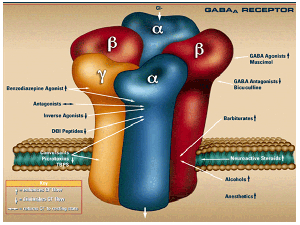
Comparing benzodiazepine antagonists starts with flumazenil, which is still the most widely used reference ligand at the benzodiazepine site of the GABA-A receptor. This article explores how flumazenil compares with experimental benzodiazepine antagonists in terms of binding, functional effects, and practical use in lab and preclinical research, while also highlighting important limitations and open questions.
Content overview
Introduction to benzodiazepine antagonists and flumazenil
Flumazenil: core properties and receptor pharmacology
Experimental benzodiazepine antagonists: why they are developed
Comparing flumazenil and experimental compounds at GABA-A subtypes
Flumazenil vs experimental antagonists in functional assays
Flumazenil vs experimental compounds in imaging and tracer research
Practical pros and cons of flumazenil as a research standard
Limitations of flumazenil and experimental antagonists
Summary
FAQ
References
Introduction to benzodiazepine antagonists and flumazenil
Benzodiazepine-site ligands at the GABA-A receptor include positive modulators, inverse modulators, and antagonists. Antagonists are especially valuable in research because they occupy the benzodiazepine binding pocket without strongly enhancing or suppressing GABA-evoked currents in many systems, allowing investigators to separate benzodiazepine-site effects from other mechanisms.
Flumazenil is the prototypical benzodiazepine antagonist. It binds to the benzodiazepine site on GABA-A receptors and can displace classical benzodiazepines, making it the standard comparator for new experimental benzodiazepine antagonists and mixed-profile ligands. Comparing flumazenil with experimental compounds helps clarify how subtle changes in structure translate into changes in receptor kinetics, subtype specificity, and network-level responses in preclinical models.
Flumazenil: core properties and receptor pharmacology
Flumazenil is an imidazobenzodiazepine with high affinity for the classical benzodiazepine site on GABA-A receptors that contain α1, α2, α3, or α5 together with γ2. At this site, it competes directly with benzodiazepine agonists and inverse agonists. In many electrophysiological preparations, flumazenil on its own produces little change in GABA-evoked chloride currents, so it is commonly described as a neutral or near-neutral antagonist. Flumazenil’s receptor kinetics /what-happens-when-benzodiazepine-antagonists-bind-a-scientific-breakdown-of-receptor-kinetics/ are characterized by rapid onset and offset, owing to its reversible binding profile.
At the molecular level, flumazenil binds in the extracellular domain pocket formed between the α and γ2 subunits. Structural and mutagenesis studies show that conserved residues in the α subunit and γ2 subunit create a binding environment that can accommodate imidazobenzodiazepine scaffolds. Flumazenil’s binding mode stabilizes receptor conformations that resemble the GABA-only state rather than the agonist-potentiated state, which explains its ability to block benzodiazepine-induced enhancements without strongly shifting basal activity.
Experimental benzodiazepine antagonists: why they are developed
While flumazenil is well suited as a general benzodiazepine antagonist, experimental antagonists are developed for several reasons:
To explore how modifications to the benzodiazepine or imidazole rings alter binding affinity and intrinsic efficacy
To generate ligands with greater selectivity for particular α-subunit combinations, such as α2/α3 over α1 or α5
To create radioligands or fluorescent probes with improved imaging properties, including longer half-life or reduced nonspecific binding
To probe the boundary between neutral antagonism and partial inverse agonism or partial agonism
These experimental compounds are tested alongside flumazenil in receptor-binding studies, electrophysiological recordings, and sometimes behavioral or network-level models, to identify differences that may be leveraged for specific research questions.
Comparing flumazenil and experimental compounds at GABA-A subtypes
GABA-A receptors are assembled from multiple subunits, and benzodiazepine-site pharmacology depends strongly on the α subunit isoform. Flumazenil binds across α1-, α2-, α3-, and α5-containing receptors with relatively high affinity, making it broadly representative of classical benzodiazepine-site recognition. This broad profile is useful when researchers want a single antagonist to survey benzodiazepine sensitivity across many brain regions or preparations.
Experimental benzodiazepine antagonists, by contrast, are often designed to favor particular α subtypes or to avoid others. Substitutions on the benzodiazepine ring, variations in the imidazole moiety, or entirely different scaffolds can bias binding toward α2/α3-rich circuits or reduce binding at α1- or α5-containing receptors. These design choices are helpful when researchers want to target limbic or spinal pathways more selectively, for example, or distinguish hippocampal tonic inhibition from widespread α1-mediated phasic inhibition. In such studies, flumazenil usually remains in the experimental panel as the “pan–benzodiazepine-site” reference against which more selective profiles are compared.
Flumazenil vs experimental antagonists in functional assays
Functional assays, particularly electrophysiological recordings, provide critical information about how flumazenil and experimental antagonists influence GABA-evoked currents. In many native preparations, flumazenil alone produces minimal change in current amplitude or decay kinetics, while reliably reversing the potentiation or suppression caused by benzodiazepine agonists or inverse agonists. This behavior supports its use as a relatively neutral comparator.
Experimental antagonists may behave differently. Some compounds with antagonist-like competitive binding can still show small but measurable inverse modulatory effects, slightly reducing GABA-evoked currents even in the absence of other benzodiazepine-site ligands. Others display partial agonist behavior with modest potentiation of GABA responses. These mixed profiles can be informative for mapping conformational landscapes of the receptor but may be less desirable when a purely neutral antagonist is needed. When these compounds are tested alongside flumazenil in identical preparations, differences in maximal inhibition of agonist effects, onset and offset times, and baseline current changes reveal how intrinsic efficacy and kinetics diverge.
Behavioral and systems-level assays in animal models extend these comparisons. For instance, flumazenil may fully block the effect of a non-selective benzodiazepine agonist in a given paradigm, while an experimental antagonist with subtype bias might only partially reverse it, depending on which receptor populations drive the measured behavior. Such differences underscore that “antagonist” is not a single functional category; flumazenil represents one point in a continuum that experimental compounds populate in different ways.
Flumazenil vs experimental compounds in imaging and tracer research
Flumazenil has served as the scaffold for several positron emission tomography (PET) tracers used to study benzodiazepine-sensitive GABA-A receptors in vivo. Carbon-11 and fluorine-18 labeled flumazenil analogues allow researchers to measure binding potential and apparent receptor availability in cortex, hippocampus, and other regions under research protocols. These tracers have relatively well-defined kinetic properties and have been extensively validated in both animals and humans.
Experimental benzodiazepine antagonists are being explored as alternative tracer scaffolds. By modifying the flumazenil structure or using different chemotypes, researchers aim to improve brain penetration, enhance metabolic stability, or achieve more selective targeting of particular α subtypes. For example, experimental ligands may be designed to enrich signal from α5-containing receptors in hippocampus or to minimize off-target binding in white matter. When these candidate tracers are evaluated, radiolabeled flumazenil is typically the standard against which binding potential, non-specific uptake, and regional distribution are compared.
However, increased selectivity can be a double-edged sword. A tracer based on an experimental antagonist with strong subtype bias may provide high contrast in selected regions but miss other relevant receptor populations where flumazenil-based tracers still show robust binding. As a result, flumazenil often remains the preferred tracer for broad surveys of benzodiazepine-site receptors, while experimental antagonists serve niche roles where more targeted imaging is required.
Practical pros and cons of flumazenil as a research standard
From a practical standpoint, flumazenil offers several clear advantages in research environments:
It is commercially available from multiple suppliers at high purity with detailed certificates of analysis.
Its physicochemical properties and chromatographic behavior are well characterized, simplifying quality control and assay validation.
Its receptor pharmacology has been studied in depth, providing a rich backdrop of reference data for new experiments.
These features make flumazenil a dependable standard for calibration and cross-study comparison. In many labs, flumazenil is the default benzodiazepine antagonist included in receptor-binding panels and electrophysiological test batteries.
However, there are also drawbacks. Flumazenil’s broad subtype profile means that it cannot distinguish between α1-, α2-, α3-, and α5-mediated effects on its own; it simply reports whether a mechanism is benzodiazepine-site dependent or not. Additionally, its relatively short duration of action in vivo and sensitivity to metabolic pathways can limit its utility in longer-term protocols, prompting the search for experimental antagonists with altered pharmacokinetic properties. For some questions—such as isolating limbic α2/α3 circuits or selectively probing hippocampal α5-mediated currents—flumazenil may be too general, pushing researchers toward more specialized antagonists.
Limitations of flumazenil and experimental antagonists
A balanced comparison of flumazenil and experimental benzodiazepine antagonists must address limitations on both sides. For flumazenil, key limitations include:
Context-dependent neutrality: in certain recombinant receptor assemblies, flumazenil shows small inverse modulatory effects, indicating that it is not absolutely neutral under all conditions.
Lack of strong subtype selectivity: while it binds across classical benzodiazepine-sensitive subtypes, it does not strongly discriminate among α1-, α2-, α3-, and α5-containing receptors, which can limit resolution in finely targeted experiments.
Pharmacokinetic constraints: in vivo, relatively rapid clearance and a limited duration of action can complicate experimental designs that require stable, long-lasting benzodiazepine-site blockade.
Experimental antagonists bring their own limitations:
Incomplete characterization: many experimental ligands are described in only a few studies, so their full kinetic, metabolic, and safety profiles may not be well defined.
Mixed intrinsic activity: compounds intended as antagonists may in practice display partial inverse or partial agonist effects, which can confound interpretation if they are assumed to be neutral.
Narrow applicability: highly specialized ligands optimized for particular subtypes or models may perform well in those specific contexts but generalize poorly to other preparations, species, or readouts.
These limitations highlight that flumazenil and experimental benzodiazepine antagonists are complementary rather than interchangeable tools. Robust research strategies often combine flumazenil with carefully selected experimental compounds to triangulate receptor mechanisms from multiple pharmacological angles.
Summary: how flumazenil and experimental antagonists complement each other
Flumazenil remains the cornerstone benzodiazepine antagonist in GABA-A receptor research because it provides a well-characterized, broadly active reference at the classical benzodiazepine site. Its high affinity, relatively neutral functional profile, and extensive validation make it ideal for defining whether an effect is benzodiazepine-site dependent and for standardizing assays across laboratories.
Experimental benzodiazepine antagonists extend this foundation by introducing targeted variations in affinity, intrinsic efficacy, subtype selectivity, and kinetic behavior. These compounds enable more refined questions about specific receptor subtypes, circuit-level contributions, and the detailed energetics of allosteric modulation. Their use, however, requires careful consideration of incomplete characterization and mixed intrinsic activities.
Taken together, flumazenil and experimental antagonists form a complementary toolkit. Flumazenil anchors comparisons and provides a robust baseline, while experimental compounds supply the fine-grained pharmacological contrasts needed to map how subtle differences in ligand structure and receptor composition shape benzodiazepine-site signaling in lab and preclinical models.
FAQ
Why is flumazenil still the main reference benzodiazepine antagonist?
Flumazenil is widely available, chemically well defined, and deeply studied at the receptor level. It binds with high affinity to the classical benzodiazepine site across multiple GABA-A receptor subtypes and typically shows low intrinsic activity, making it a dependable standard for identifying benzodiazepine-site contributions in diverse experimental systems.
Do experimental benzodiazepine antagonists replace flumazenil in research?
In most cases, they do not replace but complement flumazenil. Experimental antagonists are often used alongside flumazenil to explore specific questions about subtype selectivity, kinetics, or intrinsic efficacy. Flumazenil usually remains in experimental panels to provide a common reference point for comparison.
How do researchers decide whether to use flumazenil or an experimental antagonist?
The choice depends on the experimental goal. For broad assessment of benzodiazepine-site involvement or cross-study comparability, flumazenil is often preferred. When a study requires selective probing of particular GABA-A receptor subtypes, unusual kinetic profiles, or specialized imaging properties, experimental antagonists may be prioritized, typically with flumazenil as a control.
Can an antagonist that is not fully neutral still be useful?
Yes. Antagonists with weak inverse or partial agonist activity can be useful for mapping how small changes in intrinsic efficacy translate into functional and behavioral outcomes. They help define the continuum between pure antagonism and modulation. The key is to recognize and quantify their intrinsic activity rather than assume neutrality.
What is one major limitation shared by both flumazenil and experimental antagonists?
A major shared limitation is that ligand behavior can be highly context dependent. Subunit composition, receptor localization, expression system, and experimental conditions can all influence binding, efficacy, and kinetic parameters. Results obtained with flumazenil or experimental antagonists in one model may not directly translate to another without careful validation.
- https://www.sciencedirect.com/science/article/abs/pii/S0361923015300666
- https://pmc.ncbi.nlm.nih.gov/articles/PMC5326685/
- https://www.sciencedirect.com/science/article/abs/pii/S0168010208000795
- https://pmc.ncbi.nlm.nih.gov/articles/PMC7139822/
- https://jamanetwork.com/journals/jamapsychiatry/fullarticle/204145
- https://www.nature.com/articles/s41467-022-32212-4
- https://journals.sagepub.com/doi/abs/10.1177/02698811221082466
- https://clinicaltrials.gov/study/NCT03462641