Content overview
- Introduction
- What is flumazenil?
- Why reference standards matter
- Physicochemical properties relevant to standards
- Purity, stability, and certificate of analysis
- Flumazenil in chromatographic method development
- Use in LC–MS and metabolite identification
- Radiochemical applications and PET tracer quality control
- Handling, solubility, and storage considerations
- Regulatory and compendial context
- Summary
- FAQ
- References
Introduction
Flumazenil is widely recognized in neuropharmacology as a benzodiazepine-site GABA-A receptor antagonist, but it also holds a prominent place in analytical chemistry. As laboratories develop and validate assays for benzodiazepines, their metabolites, and related radiotracers, flumazenil frequently appears as a preferred reference standard. In this context, it is not a therapeutic agent but a calibration and quality control tool that anchors analytical measurements.
Analytical reference standards must satisfy demanding criteria for identity, purity, stability, and documentation. Flumazenil’s well-characterized structure, commercial availability from multiple certified suppliers, and inclusion in pharmacopeial monographs have made it a dependable choice for high‑precision work in chromatography, mass spectrometry, and radiochemistry.
What is flumazenil?
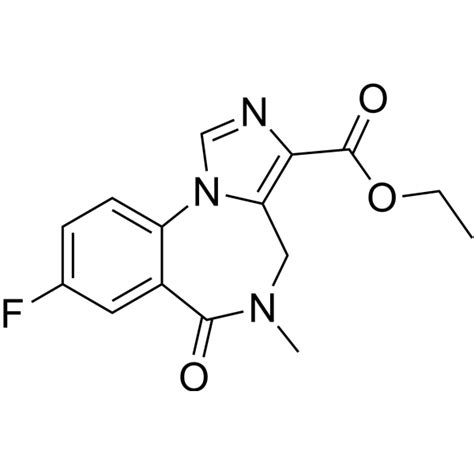
Flumazenil is an imidazobenzodiazepine compound with the CAS number 78755-81-4 and a molecular formula of C15H14FN3O3. It binds competitively at the benzodiazepine site on GABA-A receptors and is often described in the research literature as a benzodiazepine antagonist or weak partial agonist, depending on the model used. From an analytical perspective, this receptor pharmacology primarily matters because it has driven extensive structural, metabolic, and radiolabeling studies that precisely characterize the molecule.
Commercial vendors supply flumazenil as a crystalline solid with well-defined spectral, chromatographic, and purity data. These characteristics, combined with long-standing use in pharmacology, mean that identity can be confirmed by multiple orthogonal techniques, including NMR, IR, UV, and high-performance liquid chromatography (HPLC).
Why reference standards matter
In analytical chemistry, reference standards are substances of known identity and purity used to calibrate instruments, validate methods, and establish traceability across measurements. For small-molecule drugs and metabolites, the reference standard defines the retention time, ionization pattern, and response factor used to quantify analytes in complex matrices. Flumazenil, meeting the USP standards /usp-grade-flumazenil-why-united-states-pharmacopeia-standards-matter-for-research/, is stable and readily available for use as an analytical reference standard.
A preferred reference standard such as flumazenil offers several advantages:
- High chemical and isomeric purity for accurate response factors
- Detailed certificates of analysis specifying assay, impurities, and uncertainty
- Consistency across batches, allowing inter-laboratory comparison
- Where applicable, alignment with pharmacopeial requirements
Because flumazenil is used in both non-radioactive and radiolabeled forms, well-characterized standards are essential for correlating UV, MS, and radioactivity signals across different analytical platforms.
Physicochemical properties relevant to standards
For a compound to function effectively as a reference standard, its physicochemical profile must be compatible with typical analytical workflows. Flumazenil is usually supplied as a white crystalline solid, sparingly soluble in water but readily soluble in organic solvents such as dimethyl sulfoxide (DMSO), methanol, and acetonitrile. Suppliers often recommend preparing concentrated stocks in DMSO and then diluting into aqueous buffers for chromatographic use.
Spectroscopically, flumazenil shows a distinct UV absorption maximum around the mid‑UV range, enabling sensitive detection by UV or diode-array detectors in HPLC assays. Its relatively stable structure under normal laboratory conditions, along with defined storage recommendations (commonly at sub‑zero temperatures and protected from light), supports long-term use with minimal degradation when handled correctly.
Purity, stability, and certificate of analysis
One reason flumazenil is favored as a reference standard is the level of characterization provided by specialized standards manufacturers who adhere to strict quality protocols. Analytical-grade flumazenil is typically supplied with:
- Assay values (e.g., ≥98–99% purity by HPLC)
- Limits on specified impurities, sometimes referencing compendial limits
- Information on residual solvents and water content
- Stability statements and recommended storage conditions
- Batch-specific chromatograms and spectra
For example, product information sheets from reference-standard suppliers emphasize that flumazenil is stable for several years under recommended storage, with batch-specific analytical results supplied on each certificate of analysis. Pharmacopeial documents further specify system suitability criteria—such as minimum resolution between flumazenil and known impurities—to ensure that chromatographic systems can reliably separate the analyte from its degradation products under test conditions.
Flumazenil in chromatographic method development
Flumazenil’s strong UV response, moderate polarity, and well-defined impurity profile make it an attractive target for method development in reversed-phase HPLC and UHPLC. Analytical laboratories use flumazenil standards to:
- Optimize mobile phase composition and gradient profiles
- Establish retention times and resolution requirements
- Validate linearity, accuracy, precision, and limits of detection and quantification
Method development often involves testing flumazenil across different stationary phases—such as C18 columns—with varying organic modifier content (acetonitrile or methanol) and buffer conditions. Because flumazenil has a relatively narrow, symmetrical peak under optimized conditions, it provides a clear benchmark for assessing column performance and system suitability.
Flumazenil is also frequently analyzed by LC–MS and LC–MS/MS, where it serves as a reference compound for both parent drug detection and metabolite profiling. In metabolite identification studies, the flumazenil standard defines the exact mass, retention time, and fragmentation pattern that researchers use to distinguish the parent molecule from its biotransformation products. This is especially important when characterizing hepatic metabolites, where oxidation, hydrolysis, and conjugation reactions generate multiple species that must be structurally assigned relative to the parent drug.
In quantitative LC–MS assays, flumazenil can serve as either the primary analyte or a calibrant used to validate linear response, matrix effects, and ion suppression. When stable isotope–labeled internal standards are available, they are typically calibrated against a high-purity flumazenil reference, ensuring accurate quantification across different biological matrices such as liver microsomes, plasma, or brain tissue homogenates.
Radiochemical applications and PET tracer quality control
Flumazenil is a key scaffold for positron emission tomography (PET) tracers that image benzodiazepine-sensitive GABA-A receptors, particularly [11^{11}11C]- and [18^{18}18F]-labeled analogues. In radiochemistry, non-radioactive (cold) flumazenil standards are indispensable for quality control and method validation. They define the retention time and UV/LC–MS characteristics against which radiolabeled products and side products are compared.
Selecting a reliable supplier for flumazenil reference materials is a critical step for any analytical laboratory aiming to maintain rigorous quality control. The accuracy of chromatographic and mass spectrometric data ultimately depends on the traceability and certified purity of the standards being used. By partnering with reputable manufacturers who adhere to strict international quality management systems, researchers can confidently integrate these compounds into their validation protocols. This careful vendor selection process not only safeguards the overall integrity of the assays but also ensures full compliance with evolving regulatory expectations across both pharmaceutical and radiochemical research fields.
Quality control for PET tracers typically requires:
- Radiochemical purity (percentage of total radioactivity in the desired species)
- Chemical purity (amount of non-radioactive contaminants)
- Identity confirmation via co-injection with a reference standard
Here, analytical-grade flumazenil provides the benchmark for identity. By injecting both the radiotracer and the non-radioactive standard under identical HPLC conditions, analysts confirm co-elution and matching UV or MS profiles. This ensures that the radioactive peak genuinely corresponds to flumazenil or a defined analog rather than an unknown impurity.
In addition, flumazenil standards support specific activity calculations. Knowing the precise amount of non-radioactive carrier present (from the standard) allows radiochemists to compute how much of the total mass is radioactive, a key parameter in preclinical tracer dosing and receptor occupancy studies.
Handling, solubility, and storage considerations
From an analytical operations standpoint, flumazenil is relatively straightforward to handle but still requires good laboratory practice. It is usually stored as a solid at low temperature (often −20 °C or below) in tightly sealed, light-protected containers to minimize degradation. Analysts commonly prepare stock solutions in DMSO, methanol, or acetonitrile at millimolar concentrations, followed by dilution into aqueous mobile phases just before use.
Because reference standards must remain stable over time to maintain traceability, laboratories typically:
- Record preparation dates and storage conditions for each stock solution
- Use amber vials to reduce photodegradation
- Avoid repeated freeze–thaw cycles by preparing aliquots
- Periodically re-check purity by HPLC or LC–MS if a batch is kept for extended periods
These practices help ensure that flumazenil continues to function as a reliable quantitative standard rather than an uncontrolled source of variability.
Regulatory and compendial context
Flumazenil’s status as a well-established active substance means it appears in regulatory and compendial documents, which further solidify its role as a reference standard. Pharmacopoeias and product monographs typically describe:
- Identification tests based on IR, UV, and chromatographic behavior
- Assay methods specifying acceptable purity ranges
- Limits for specified and unspecified impurities
- System suitability criteria for chromatographic separations
For analytical laboratories, alignment with these monographs has two benefits. First, it provides a widely accepted baseline for purity and identity that can be adopted or adapted for in-house methods. Second, it facilitates comparability of results across laboratories, since many groups rely on common chromatographic conditions and acceptance criteria anchored to the same reference compound.
Reference-standard producers often design their flumazenil materials to be compatible with these pharmacopeial methods, listing assay values and impurity profiles that meet or exceed compendial specifications. As a result, laboratories can select flumazenil standards that integrate easily into validated workflows for drug substance or research-grade analysis.
Summary
Flumazenil occupies a unique position at the intersection of neuropharmacology and analytical chemistry. While it is best known in receptor research as a benzodiazepine-site GABA-A antagonist, its structural definition, commercial availability, and regulatory recognition have made it a preferred reference standard in many analytical laboratories.
As a reference standard, flumazenil offers:
- High and well-documented purity, supported by detailed certificates of analysis
- Favorable physicochemical properties for HPLC, LC–MS, and radiochemical workflows
- A rich body of structural and metabolic data that aids identity confirmation
- Compatibility with pharmacopeial methods and regulatory expectations
In chromatographic method development, LC–MS quantification, metabolite identification, and PET radiotracer quality control, flumazenil serves as an anchor compound that brings consistency and traceability to analytical measurements. This role is independent of any medical claims and is grounded in its value as a precisely characterized molecular standard for laboratory, preclinical, and receptor-level research.
FAQ
Why is flumazenil often chosen over other benzodiazepine-site ligands as a reference standard?
Flumazenil has a well-defined structure, extensive historical characterization, and broad commercial availability from certified standard suppliers. These features make it easy to confirm identity and purity using multiple analytical techniques, which is essential for a primary reference standard.
Is flumazenil suitable for both HPLC-UV and LC–MS methods?
Yes. Flumazenil has a distinct UV absorption profile that supports sensitive detection in HPLC-UV, and it ionizes well under typical LC–MS and LC–MS/MS conditions, producing characteristic fragment ions useful for identification and quantification.
How is flumazenil used in PET tracer quality control?
Non-radioactive flumazenil standards are injected alongside [11^{11}11C]- or [18^{18}18F]-labeled analogues to confirm co-elution and matching spectral properties. This verifies tracer identity and supports calculations of radiochemical purity and specific activity.
What storage conditions are recommended for flumazenil reference standards?
Standards are typically stored as solids at low temperatures (for example, −20 °C), protected from light and moisture. Stock solutions are prepared in organic solvents and kept in sealed, light-resistant vials, often as aliquots to avoid repeated freeze–thaw cycles.
Does the receptor pharmacology of flumazenil matter for its use as a standard?
Only indirectly. Its role as a benzodiazepine-site ligand has motivated extensive structural and metabolic studies, which in turn provide detailed analytical data. This depth of characterization is what makes flumazenil a robust reference standard, but the analytical use itself does not depend on pharmacological activity.
Can flumazenil standards be traced to pharmacopeial references?
Many commercial flumazenil standards are designed to be compatible with pharmacopeial monographs, and their certificates of analysis often reference methods or purity specifications aligned with compendial requirements, facilitating method validation and regulatory compliance.
References
- https://www.medchemexpress.com/flumazenil-acid-standard.html
- https://pmc.ncbi.nlm.nih.gov/articles/PMC11708791/
- https://pmc.ncbi.nlm.nih.gov/articles/PMC10223822/
- https://pubmed.ncbi.nlm.nih.gov/1996802/
- https://www.medchemexpress.com/flumazenil-standard.html
- https://cdn.caymanchem.com/cdn/insert/14252.pdf
- http://www.uspbpep.com/ep60/flumazenil%201326e.pdf
- https://go.drugbank.com/drugs/DB01205
- https://www.lgcstandards.com/US/en/p/MM0762.00
- https://www.chemicalbook.com/ProductChemicalPropertiesCB9208108_EN.htm